


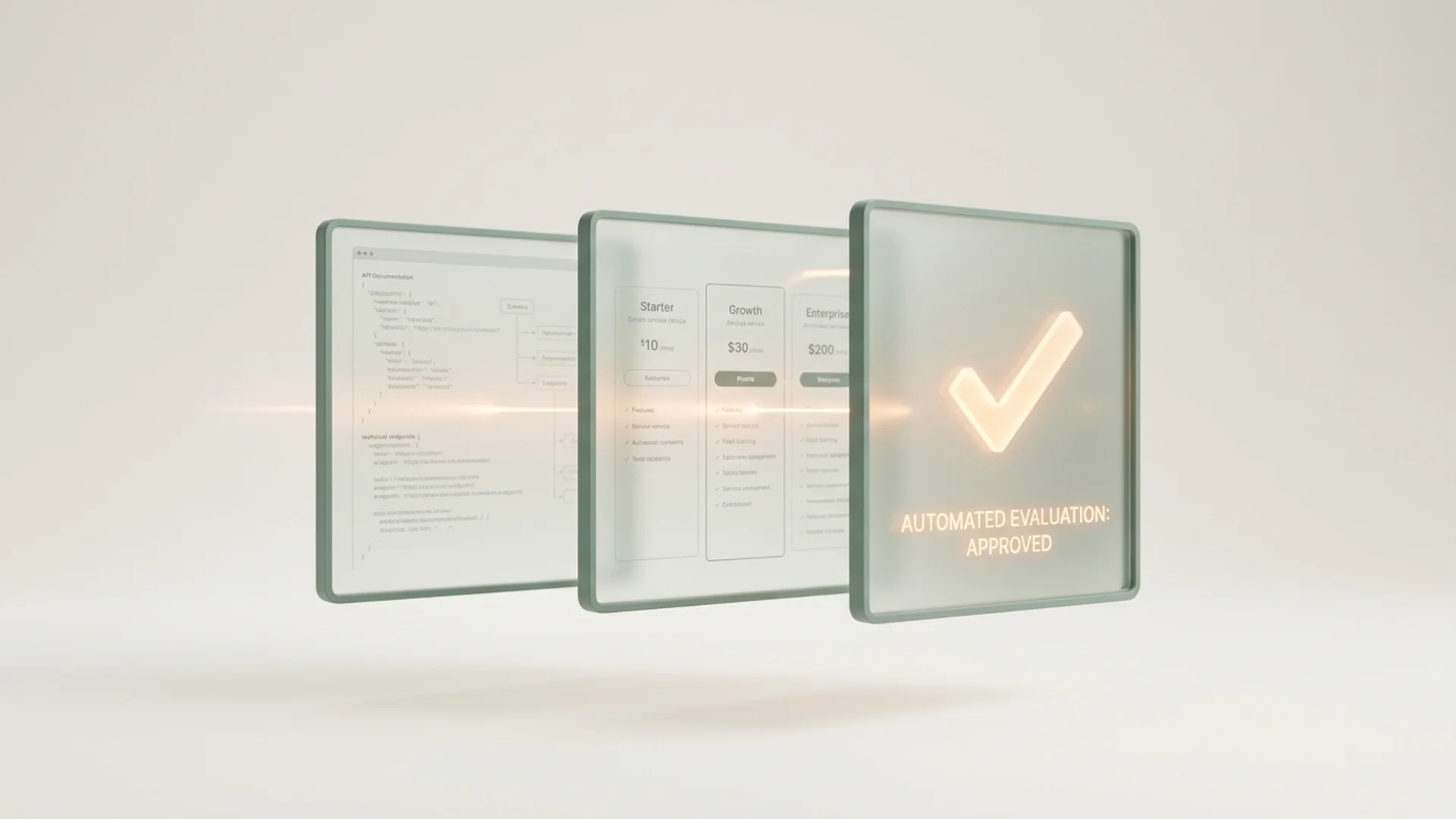
A fundamental transformation is reshaping the B2B SaaS buying journey. Where prospective enterprise buyers once attended webinars, downloaded gated whitepapers, and waited for sales callbacks, procurement committees now delegate initial vendor research directly to AI models like Claude Enterprise and ChatGPT Team. Discover why SaaS vendors hiding documentation behind logins, gated PDFs, or complex JavaScript portals are being silently disqualified before the first sales demo.
Key Takeaways
The Autonomous Software Shortlist: Enterprise buying teams task AI reasoning models with evaluating prospective vendors based on API schemas, uptime SLAs, SOC2/GDPR compliance, and transparent pricing models.
The ‘Gated Content’ Disqualification: When an AI selection agent encounters a mandatory lead capture form or login barrier, it assigns a zero-transparency score and eliminates the vendor from consideration.
The Machine-Native Solution: Structure technical specifications, API reference documentation, and tiered pricing formulas into clean, machine-queryable Markdown feeds (
/llms.txt).
The Collapse of Friction-Based Lead Generation
Traditional B2B software marketing was built on ‘lead capture gates’: buyers surrendered business email addresses and phone numbers to unlock technical whitepapers or pricing calculators, triggering outbound SDR outreach.
In 2026, this friction-heavy model actively repels enterprise procurement:
- AI-Driven Requirements Filtering: A CIO prompts their enterprise assistant: “Compare the top 5 enterprise identity providers offering SAML 2.0, SCIM provisioning, and EU data residency, including monthly tiered costs for 2,500 seats.”
- Autonomous Documentation Scraping: The AI engine queries public vendor documentation to verify whether endpoints and compliance standards satisfy technical prerequisites.
- The Instant Shortlist: Only software vendors whose API specifications and pricing logic are machine-verifiable in seconds make the executive recommendation briefing.
Why Heavy JS Portals and PDFs Fail AI Evaluation
Many SaaS vendors build elaborate documentation portals using single-page JavaScript frameworks. While visually impressive for human developers, these portals present severe barriers to AI evaluation agents:
Client-Side Rendering Delays: AI search crawlers do not wait for heavy client-side bundles to execute. Endpoints embedded in dynamic tabs are frequently missed during scraping.
Gated PDF Brochures: Specs locked inside downloadable PDFs consume excessive token budgets and lack standardized semantic schemas.
Opaque ‘Contact Sales’ Pricing: Hiding transparent pricing tiers leads AI agents to classify the vendor as ‘High Commercial Risk / Opaque’.
The Solution: Zero-Friction Machine-Readable Docs
To ensure your SaaS product consistently commands the top spot on enterprise AI procurement shortlists, implement a Dual-Interface documentation strategy:
- Publish Clean Markdown Feeds: Alongside your visual documentation hub, serve an automated Markdown endpoint (
/docs/llms.txt) detailing all API methods, auth schemas, and rate limits. - Expose Machine-Readable Compliance Proofs: Include structured schema tags for ISO27001, SOC2 Type II, and GDPR data processing agreements.
- Transparent Algorithmic Pricing: Provide explicit formula-based pricing tiers that reasoning engines can compute for arbitrary seat numbers.
LLMentry: The Turnkey Machine Front-Door for B2B SaaS
LLMentry equips your SaaS platform with a dedicated, machine-readable documentation layer in under 24 hours. While your growth team continues acquiring human visitors through visual web pages, LLMentry ensures enterprise AI procurement agents discover, validate, and select your software.
FAQ (Frequently Asked Questions)
Why do enterprise procurement committees rely on Claude and ChatGPT to build software shortlists?
Enterprise IT and purchasing committees save hundreds of hours by having reasoning models analyze and cross-reference hundreds of pages of API specifications, SLA terms, and compliance matrices in seconds.
Does deploying machine-readable documentation expose proprietary SaaS code?
No. You only expose public API schemas, documentation parameters, and pricing formulas formatted for machine readability. Your proprietary backend source code remains completely secure.
How does LLMentry automate documentation readiness for SaaS platforms?
LLMentry indexes your existing documentation portal and automatically publishes synchronized /docs/llms.txt and /llms-full.txt endpoints that update seamlessly with every new software release.